

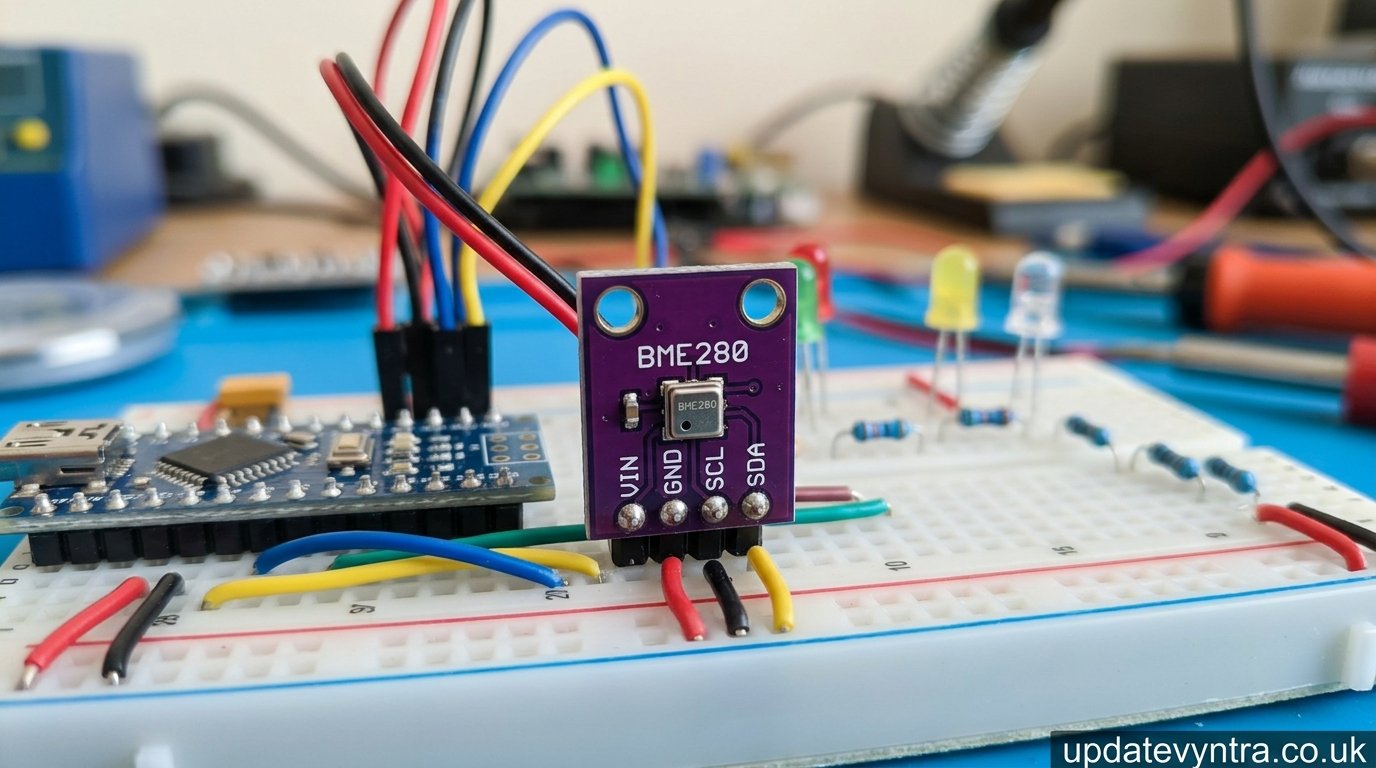
The BME280 is one of the most widely used environmental sensors in modern electronics, offering an efficient solution for measuring temperature, humidity, and atmospheric pressure with a single compact device. Developed by Bosch Sensortec, this digital sensor has become a standard component in countless Internet of Things (IoT) devices, weather stations, industrial monitoring systems, smart home applications, agricultural projects, and embedded systems. Its combination of high accuracy, low power consumption, compact size, and reliable performance makes it suitable for both beginners building their first electronics project and professional engineers designing commercial products.
As connected devices continue to grow in popularity, the demand for accurate environmental monitoring has increased significantly. From predicting weather changes to maintaining ideal greenhouse conditions and monitoring indoor air quality, reliable environmental data plays an important role in modern technology. The BME280 addresses these needs by combining three essential sensors into one integrated circuit while supporting both I2C and SPI communication protocols for easy integration with popular development boards such as Arduino, ESP32, ESP8266, Raspberry Pi, STM32, and many others.
Another reason for the sensor’s widespread adoption is its excellent balance between performance and energy efficiency. Battery-powered IoT devices often require components that can operate for months or even years without frequent maintenance. The BME280 consumes extremely little power while maintaining consistent measurement quality, making it one of the preferred choices for portable electronics, wireless sensor networks, wearable devices, and remote monitoring stations. This guide explores every important aspect of the BME280, including its working principle, specifications, applications, communication methods, calibration, installation practices, and future significance in modern electronics.
Understanding the BME280 Sensor
The BME280 is a digital environmental sensor manufactured by Bosch Sensortec, a company recognized worldwide for developing advanced microelectromechanical systems (MEMS). Unlike traditional environmental sensors that measure only one or two parameters, the BME280 combines temperature, relative humidity, and barometric pressure sensing within a single compact package. This integration reduces circuit complexity, lowers hardware costs, simplifies PCB design, and minimizes the number of external components required in electronic systems.
Internally, the sensor contains independent sensing elements for each environmental parameter. These sensing elements work together through sophisticated analog and digital circuitry to deliver highly accurate compensated measurements. Every sensor is factory calibrated during manufacturing, and the calibration data is permanently stored inside the device. When measurements are taken, the internal processor automatically applies compensation algorithms to improve accuracy before transmitting digital values to the connected microcontroller.
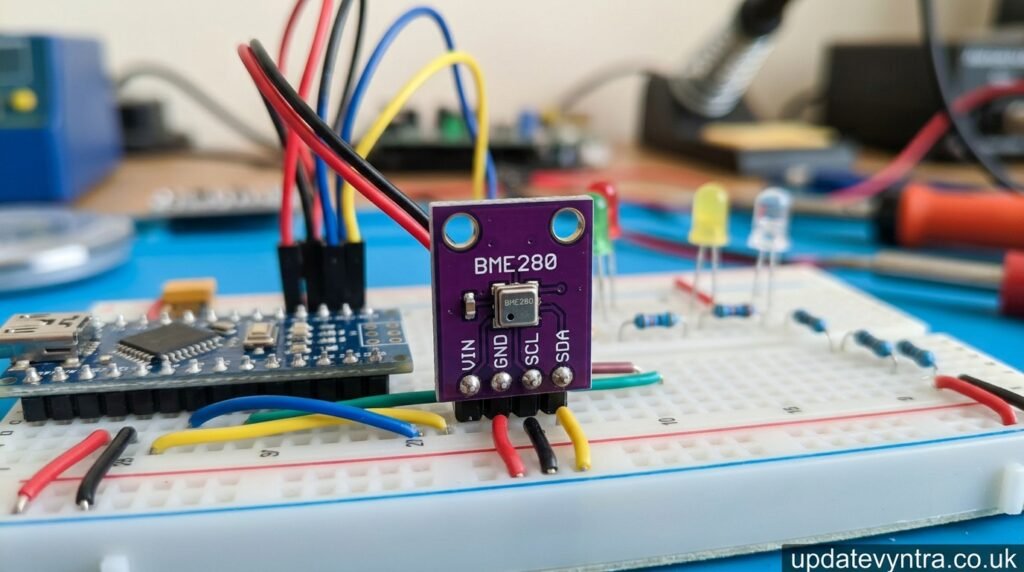
The BME280 supports two widely used communication interfaces: Inter-Integrated Circuit (I2C) and Serial Peripheral Interface (SPI). This flexibility allows developers to connect the sensor to nearly every modern microcontroller platform without requiring specialized hardware. Whether a project involves a simple Arduino weather station or a complex industrial monitoring system, the BME280 can be integrated with minimal programming effort through well-supported software libraries.
How the BME280 Measures Environmental Conditions
The BME280 performs environmental monitoring using three different sensing technologies that operate together inside a miniature MEMS structure. The temperature sensor measures ambient temperature using semiconductor technology capable of detecting very small thermal changes. Temperature measurement is important not only for reporting environmental conditions but also because it helps compensate pressure and humidity calculations, ensuring greater overall accuracy.
Atmospheric pressure is measured using a highly sensitive piezoresistive pressure sensor. This sensing element reacts to changes in air pressure by detecting microscopic mechanical deformation within a flexible membrane. The resulting electrical signals are converted into digital values through precision analog-to-digital converters. Atmospheric pressure measurements can be used for weather forecasting, altitude estimation, drone navigation, aviation experiments, and numerous scientific applications.
Humidity measurement relies on a capacitive sensing element that changes its electrical characteristics according to the amount of moisture present in the surrounding air. The sensor continuously monitors relative humidity while compensating for temperature variations to produce stable readings. Because all three sensing elements operate together and share internal calibration information, the BME280 delivers reliable environmental data across a wide range of operating conditions with minimal user intervention.
Technical Specifications and Performance Characteristics
The BME280 is designed to operate reliably under a broad range of environmental conditions. It measures temperatures from approximately -40°C to 85°C, making it suitable for outdoor weather monitoring, industrial environments, agricultural systems, and consumer electronics. Relative humidity measurements cover the full range from 0% to 100% RH, while atmospheric pressure measurements span roughly 300 hPa to 1100 hPa. This pressure range enables accurate operation from below sea level to high-altitude mountain regions.
One of the sensor’s strongest features is its excellent measurement resolution and repeatability. Even small environmental changes can be detected because of the sensor’s high-resolution analog-to-digital conversion system. Multiple oversampling settings allow developers to balance response speed, measurement noise, and power consumption according to the specific requirements of their applications. Higher oversampling produces smoother measurements, while lower settings reduce energy usage and increase sampling speed.
Power efficiency is another defining characteristic of the BME280. During sleep mode, current consumption is extremely low, making it ideal for battery-operated IoT devices that wake periodically to collect environmental data before returning to low-power operation. This energy-efficient design enables wireless monitoring stations, portable weather loggers, and remote agricultural sensors to operate for extended periods using small batteries or solar power systems.
