

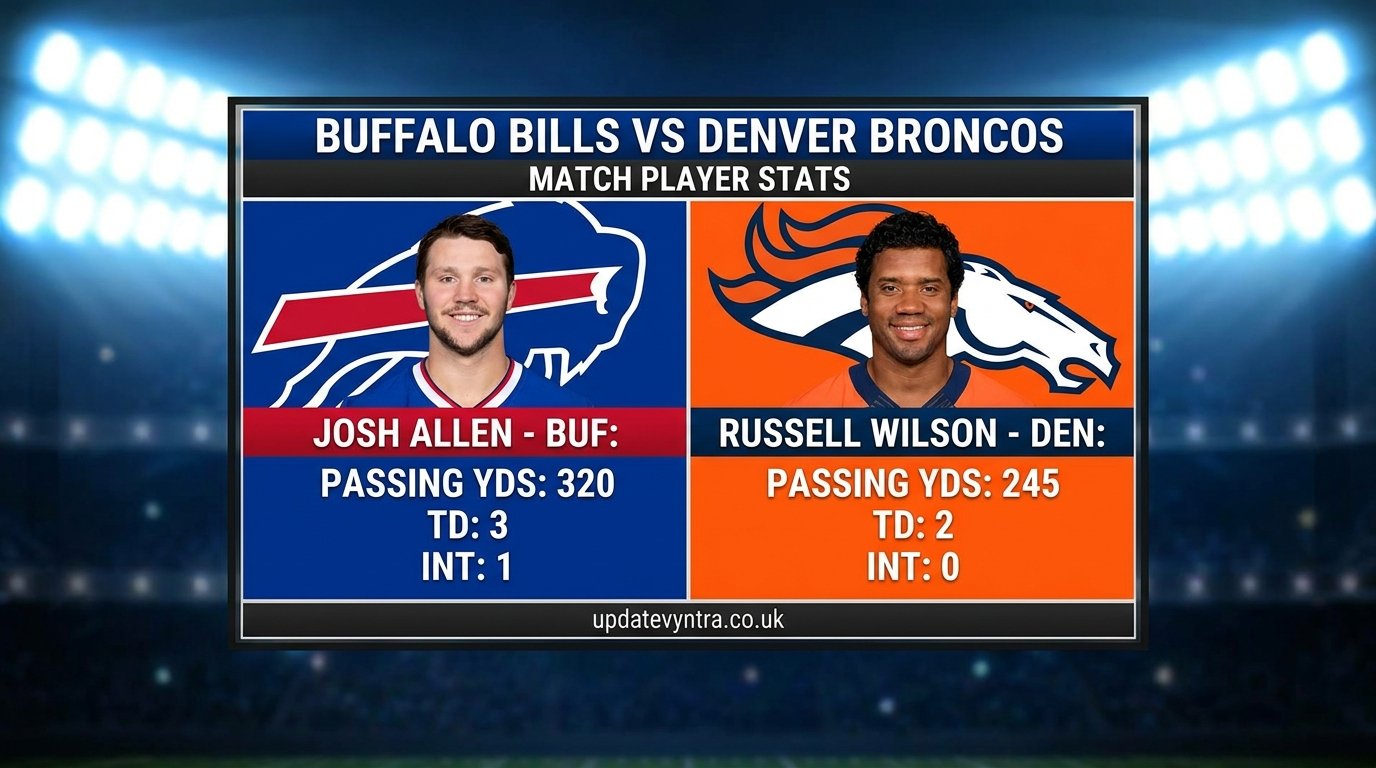
The Buffalo Bills vs Denver Broncos matchup delivered one of the most dramatic games of the 2025 NFL postseason. Played in the AFC Divisional Round on January 17, 2026, the game went to overtime before the Denver Broncos secured a 33–30 victory. Both teams produced strong offensive numbers, but turnovers and several important defensive plays ultimately shaped the result.
For fans searching for Buffalo Bills vs Denver Broncos match player stats, the game provides plenty to examine. Josh Allen threw for 283 yards and three touchdowns, while James Cook rushed for 117 yards. On Denver’s side, Bo Nix passed for 279 yards and three touchdowns and added 29 rushing yards. Despite these impressive individual performances, five Buffalo turnovers proved extremely costly.
The game also featured major contributions from players such as Dalton Kincaid, Khalil Shakir, Marvin Mims Jr., Lil’Jordan Humphrey, and several members of Denver’s defense. Looking at the numbers closely shows how a game that was statistically productive for Buffalo still ended with Denver advancing.
Josh Allen and the Buffalo Bills Passing Performance
Josh Allen was at the center of Buffalo’s offensive production. The Bills quarterback completed 25 of 39 passing attempts for 283 yards, three touchdowns, and two interceptions. He also carried the ball 12 times for 66 yards, showing once again how important his running ability was to Buffalo’s offensive approach.
Allen’s passing statistics were particularly notable because Denver entered the game with a defense capable of creating pressure and forcing mistakes. Even though the Broncos managed to disrupt Allen several times, he continued to move the football and helped Buffalo produce 449 total yards.
His three touchdown passes kept the Bills within striking distance throughout the contest. However, the two interceptions and two lost fumbles were critical. NFL.com reported that Buffalo did not punt on any of its 11 possessions, yet the team still lost because five turnovers offset much of its offensive production.
James Cook provided another major part of Buffalo’s attack. He finished with 117 rushing yards on 24 carries, averaging nearly five yards per attempt. Cook also caught two passes for 24 yards. His ability to run effectively gave Buffalo a reliable source of offense and helped the Bills establish a strong ground game against Denver.
The downside came when Cook lost a fumble in Denver territory. That turnover helped change the momentum of the game and became part of Denver’s five-turnover performance.
Buffalo’s receiving group also produced several important numbers. Dalton Kincaid caught all six of his targets for 83 yards and a touchdown. His 25-yard reception was his longest of the game, and he was an important target for Allen during a contest in which the quarterback needed dependable options.
Khalil Shakir also played a significant role. He caught seven of nine targets for 75 yards, including a 46-yard reception. His production helped Buffalo maintain drives and contributed to the team’s impressive third-down performance.
Bo Nix and the Denver Broncos Make the Most of Their Opportunities
Bo Nix delivered an important performance for Denver in his first playoff appearance. He completed 26 of 46 passes for 279 yards, three touchdowns, and one interception. Nix also rushed 12 times for 29 yards, making him Denver’s leading rusher in the game.
The passing efficiency was not perfect, but Nix made several important throws at critical moments. NFL.com noted that he completed three of four passes traveling more than 20 air yards for 82 yards and two touchdowns. Those explosive completions helped Denver generate points when the offense needed them most.
One of Nix’s most important connections came with Marvin Mims Jr. During Denver’s late fourth-quarter touchdown drive, Nix connected with Mims on a 26-yard touchdown pass. That score gave the Broncos the lead before Buffalo responded to force overtime.
Nix also connected with Lil’Jordan Humphrey for a 29-yard touchdown earlier in the game. That reception helped Denver take control late in the first half and contributed to a sequence that became extremely important.
Denver’s running game was less productive than Buffalo’s. Nix led the Broncos in rushing with 29 yards, while the team relied heavily on its passing attack and quarterback mobility. The limited rushing production meant that Nix was asked to carry a significant portion of the offensive workload.
The quarterback also threw one interception, but Denver’s defense created more turnovers than Buffalo’s defense. That difference became one of the defining statistical factors in the game.
Defensive Plays and the Turnovers That Changed the Game
The Buffalo Bills vs Denver Broncos match player stats cannot be fully understood by looking only at passing and rushing numbers. Turnovers were arguably the most important statistical category.
Buffalo committed five turnovers in total. Allen threw two interceptions and lost two fumbles, while Cook also lost a fumble. Denver converted those mistakes into 16 points, according to NFL.com.
The Broncos defense created several big plays even while allowing Buffalo to gain 449 yards. Alex Singleton forced a fumble from Cook, Nik Bonitto forced two fumbles, and P.J. Locke intercepted Allen. The defense then produced its biggest moment in overtime.
With Buffalo attempting to make a potential winning play, Allen threw deep toward Brandin Cooks. Denver defensive back Ja’Quan McMillian made a crucial interception, taking the ball away from Cooks and giving Denver another opportunity. The Broncos subsequently moved into field-goal range, allowing Wil Lutz to kick the game-winning 23-yard field goal.
This defensive performance illustrates why football statistics need context. Buffalo had more offensive yardage and moved the chains consistently, but Denver’s defense produced the plays that directly affected the scoreboard.
The Bills finished with 28 first downs and converted 10 of 15 third-down attempts. They also went one-for-one on fourth down. In many games, those numbers would strongly support a victory. Instead, the turnovers became the deciding factor.
Penalties also hurt Buffalo at important moments. The Bills were called for 68 penalty yards during the game, including 53 yards on their final possession. Two defensive pass interference calls during Denver’s overtime drive helped move the Broncos closer to the winning field goal.
The first half also contained a major momentum swing. With only seconds remaining, Allen lost a fumble on a scramble. Denver recovered and kicked a 50-yard field goal with two seconds left, turning what could have been a close halftime situation into a 10-point Broncos advantage.
Key Buffalo Bills vs Denver Broncos Match Player Stats
The major individual numbers tell the story of a highly competitive game.
For Buffalo, Josh Allen completed 25 of 39 passes for 283 yards and three touchdowns, while adding 66 rushing yards. James Cook rushed for 117 yards on 24 attempts and added 24 receiving yards. Dalton Kincaid led the Bills in receiving with six catches for 83 yards and one touchdown. Khalil Shakir added seven receptions for 75 yards.
For Denver, Bo Nix completed 26 of 46 passes for 279 yards, three touchdowns, and one interception. He also rushed for 29 yards. Marvin Mims Jr. produced the late 26-yard touchdown reception that helped Denver regain the lead. Lil’Jordan Humphrey contributed a 29-yard touchdown reception earlier in the contest.
The defensive statistics were equally important. Denver forced five Buffalo turnovers, while Buffalo intercepted Nix once. Denver’s ability to create takeaways despite allowing 449 total yards demonstrated the importance of situational defense.
The game also showed the contrasting approaches of the two offenses. Buffalo consistently moved the football and generated strong third-down numbers, while Denver benefited from explosive plays and short fields created by turnovers.
Conclusion
The Buffalo Bills vs Denver Broncos match player stats from the 2026 AFC Divisional Round show just how unusual and competitive the game was. Buffalo produced 449 yards of offense, Josh Allen threw three touchdown passes, and James Cook rushed for 117 yards. Yet those strong numbers were undermined by five turnovers.
Denver’s Bo Nix responded with 279 passing yards, three touchdown passes, and 29 rushing yards. His late touchdown pass to Marvin Mims Jr. helped send the game into its decisive final moments, while the Broncos defense produced the turnovers needed to keep Buffalo from turning its offensive production into a victory.
The final 33–30 overtime score reflected the balance of the contest. Buffalo moved the ball effectively and made several strong offensive plays, but Denver consistently capitalized on mistakes. Ja’Quan McMillian’s overtime interception and Wil Lutz’s winning field goal provided the final turning points.
Ultimately, the player statistics from this matchup demonstrate that yardage and scoring totals tell only part of an NFL game. The Bills generated more offensive yardage, but Denver’s defense created five turnovers and converted those opportunities into points. That combination allowed the Broncos to survive an overtime thriller and advance in the postseason.
